
Case Studies
Historically, feminist movements have resorted to (at least) five different ways of dealing with the experience of a care crisis. I will conduct five case studies, each dealing with one of these political strategies.
Strike
More than 5.3 million people in Spain went on strike on 8 March 2018. The strike was modelled on an Icelandic strike in 1975, in which 90% of the female population took part. Since then, strikes as a feminist, political form of organisation have been controversially discussed. I will talk to Icelandic and Spanish activists and visit archives to understand the organising processes of the strikes.
Co-operative Organisation
Cooperative housekeeping is the joining together of two or more households to share the costs and labour of reproductive tasks such as cooking, washing and cleaning. Fifteen cooperative housekeeping projects were established in England between 1874 and 1925. I will analyse the architecture of the surviving houses and use archival research to reconstruct the discourses of housework and care within the co-operative movements of the time.
Utopian Communities
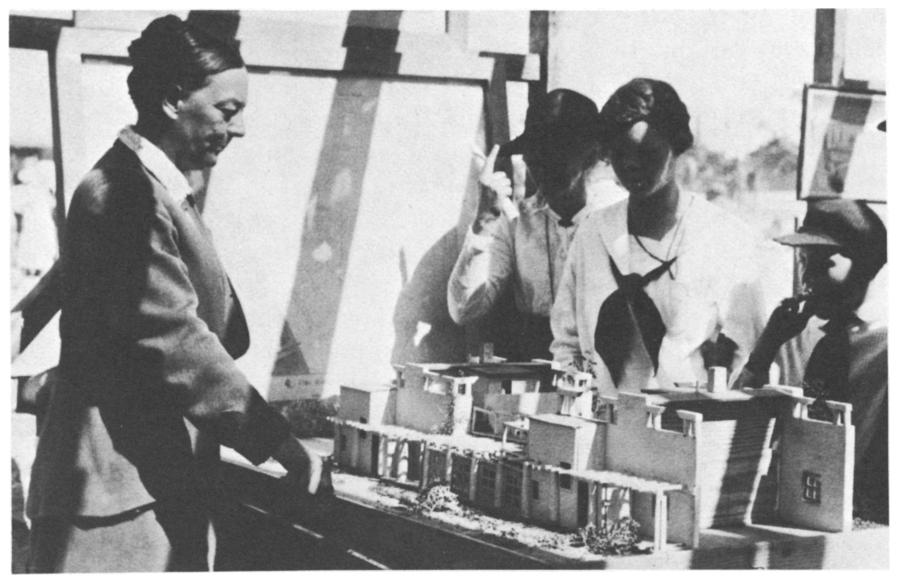
Utopian communities attempt to realise ideal concepts of communal living on a small scale. Some are religious, some are socialist or communist, and some (also) focus on feminist ideas. One such settlement is Llano del Rio (1914-1918) in California, USA. Architect Alice Constance Austin designed Llano del Rio as a circular city of kitchenless houses, each connected to a central kitchen by a complex network of underground tunnels. In the picture above, Austin presents a model of her design on May 1, 1917 (©Yale Collection of Western Americana, Beinecke Rare Book and Manuscript Library). Her aim was to free women from the burden of housework. I will be researching the history of the settlement in archives and talking to historians, activists and artists who find inspiration in the settlement today.
Fighting for Wages
In the 1970s, feminist groups around the world came together to demand wages for domestic work. Their demand was based on a feminist critique of the Marxist division between productive and reproductive labour. They insisted that the capitalist wage labour system was only possible on the condition of women’s unpaid domestic labour. In doing so, they transformed domestic work into a political arena. Today, feminists around the world remember this campaign and try to build on it. I will talk with activists about these attempts and discuss the strategy of wage demands in the context of a changed political situation.
Rationalisation
In 1912, Christine Frederick applied the Taylorist principle of optimising work processes to domestic work, particularly kitchen work. The Frankfurt kitchen, designed by the architect Margarete Schütte-Lihotzky, can be seen as the realisation of Frederick’s ideas. The Frankfurt kitchen was designed to be as practical as an industrial workplace: All important objects were to be within easy reach, and a variety of appliances were to be used to shorten work processes. I will reconstruct and discuss this attempt to rationalise housework through archival research and interviews with experts.
 Liza Mattutat